Step 1 of 7 · Consumer Behavior

Briefing

Brand, segments, mission

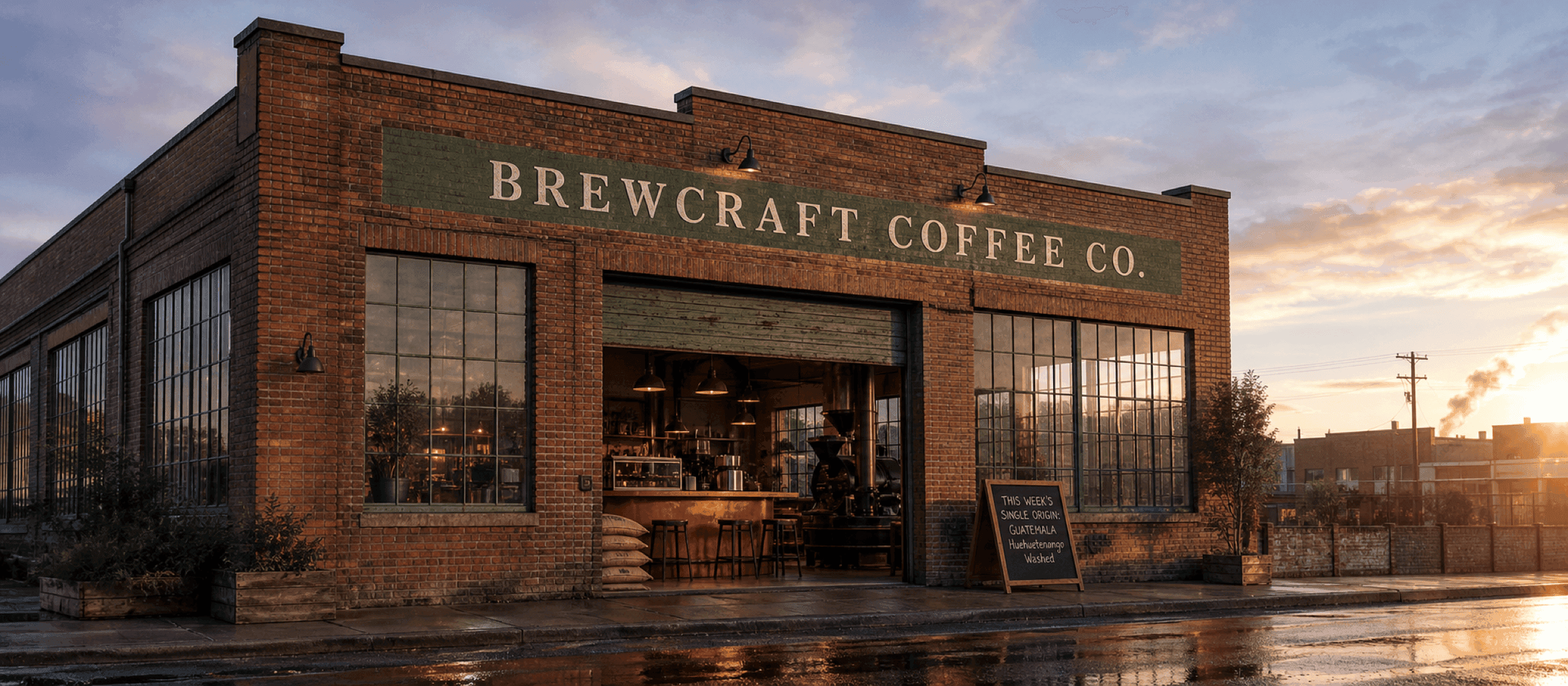
BrewCraft Coffee Co. — a converted 1940s machine shop in the Eastside Industrial District of Salem Heights
BrewCraft · Subscription Coffee Market Briefing

BrewCraft Coffee Co. is yours.

From the Eastside Industrial District of Salem Heights — four months, four psychographic segments, four rivals. Subscription coffee is a retention game — every renewal is your product.

Memo from Hayes

To: the BrewCraft growth team
From: Holden "Hayes" Marlowe, founder
Re: the next four months

I started BrewCraft in 2022 in a borrowed 600-square-foot kitchen, six months after quitting a polymers lab and spending two weeks on a farm outside San Vito learning what coffee actually is. Three years later we’re here: a converted machine shop on the Eastside, ~$3M ARR, a roaster the team named Big Bertha, and the decision in front of us that brought you in.

The wholesale margin grind is killing us. So we’re betting the next four months on D2C subscription — a monthly box that goes straight to a subscriber’s door for somewhere between $8 and $30 depending on what we put in it. The total addressable market in our category is about 20,000 specialty-coffee households, split four ways into psychographic segments. Each segment buys for a completely different reason. A strategy that lands with one will actively repel another. Pick carefully.

You will not be running this alone. Four other brands are competing for the same subscribers: Halcyon Roasters (the twelve-year-old premium incumbent — owns the Ritualists by default), Wanderlight Coffee (the influencer-and- rotating-origin show that the Discoverers love), Common Grounds (the permanent-25%-off promo machine that the Pragmatists keep coming back to), and Verdant Beans (B-Corp, fair-trade-only, and the only people the Conscious Consumers fully trust). Each of them is excellent at one thing. None of them is excellent at all four. That’s your opening.

Two things you have to internalize before you submit a single decision. First: brand assets compound. The trust you build in Round 1 is worth more than the same dollars spent in Round 3, because trust and social proof both decay between rounds and diminishing returns kick in fast. Invest early or you’ll spend the run trying to catch up. Second: discounts erode brand trust. A 30% off promo this round burns about six trust points — an entire round of trust-building, gone. Use them surgically. Never as a strategy.

That’s the brief. Read on. Then go win somebody.

— H.

What You’re Inheriting

The roastery is a converted 1940s machine shop two miles east of downtown. Copper-pipe espresso bar, exposed beams, two cupping rooms, and Big Bertha — the twelve-bag drum roaster the team threw a small birthday party for last spring. The taproom opens to subscribers on Saturdays, which is how we got most of our first thousand sign-ups: people walked in, drank a cortado, asked when the next box shipped.

The product is a monthly box. You get to shape it along three dimensions — quality (1–5), novelty & variety (1–5), and sustainability (1–5) — and you set the monthly price between $8 and $30. Each level you add to any dimension increases your cost of goods. Maxing all three is possible, but rarely the right play.

Addressable Market

20,000

specialty-coffee subscribers across the country

Consumer Segments

4

psychographic, not demographic

Rounds to Compete

4

one round = one month of decisions

The Subscription Coffee Category, in Brief

D2C subscription coffee exploded out of the pandemic. Trade, Atlas, Driftaway, Bean Box — the category is real, the consumer demand is real, and the venture money chasing it has roughly doubled customer-acquisition cost since 2022. The bottleneck for everyone working in this space has shifted from acquisition to retention. The brands that win the next decade will be the ones that figure out how to keep subscribers from churning — not the ones that figure out the cleverest paid channel.

Industry-avg monthly churn

5–7%

meaning ~half the base turns over in a year

CAC (customer acquisition cost) inflation since 2022

~2×

paid channels are saturated, cookie-cutter

The bottleneck

Retention

not acquisition, anymore

The Vocabulary You’ll Need

Six terms that show up in every section of this briefing, the playbook, and the results page. Skim now, refer back as needed.

ARR

Annual recurring revenue. What this whole business is being valued on.

COGS / sub

Cost to fulfill one subscriber per month. Quality×$2 + Novelty×$1 + Sustainability×$1.

Brand Trust

0–100 score. Builds slowly, decays 3 points per round, drains with discounts. Compounds.

Social Proof

0–100 score. 60% from your actual market share, 40% from social-proof spend. Decays fast.

Retention

% of last round’s subscribers who renew. Base 60%; trust, product fit, and CX add up to +60%.

Churn

The flip side of retention. Every churned subscriber is one you have to re-acquire.

Why Subscription Coffee Plays Differently

Three structural facts that govern almost every decision you'll make. If your strategy fights any of these, your strategy is wrong.

Brand Assets Compound

Brand trust and social proof accumulate across rounds. A $3K trust investment in R1 produces more total brand impact than the same $3K spent in R3 — earlier dollars get more rounds to compound.

Retention Is Half the Game

Every subscription begins at 60% base retention; your levers — trust, product fit, CX — can lift it to ~95%. A 90%-retention business is worth roughly 4× a 75%-retention business at scale.

One Frame Per Round

You pick one message frame. The four frames score differently in every segment — Premium Craft hits 100/100 with Ritualists and 30/100 with Pragmatists. Trying to be everything to everyone means being nothing to anyone.

Meet Your Subscribers

Four psychographic segments, each with a distinct buying logic. Your message, your price, and your product choices land differently in each.

Dana, 34, attorney, holding a hand-thrown mug at her kitchen counter at 6:45am

The Ritualists

Dana, 34, Attorney same cup, every morning

Habitual coffee drinkers who build their day around their morning cup. They want the exact same experience every week — no surprises, no variance, no gimmicks. Once they trust a brand, they stay. Earning that trust takes time. They read the roaster’s notes, notice when the blend changes, and forgive almost nothing on quality.

Buying lens

Quality & routine

Price posture

Will pay for consistency (ideal $17)

What wins them

Earned brand trust + content (recipes, roaster stories)

What loses them

Quality dips or constant variety pushes

Responds to

Premium Craft

Mateo, 26, creative director, photographing a pour-over for Instagram

The Discoverers

Mateo, 26, Creative director show me something new

Adventurous consumers who subscribe for the novelty as much as the caffeine. They love single-origin rotations, limited batches, and coffees with a story. Heavily influenced by the creators they follow, they will ditch a brand the moment it starts feeling predictable. Social proof drives their purchase — if everyone’s talking about it, they want in.

Buying lens

Novelty & discovery

Price posture

Tolerant if the story is good (ideal $20)

What wins them

Influencer drops + rotating origins

What loses them

A static, "safe" catalog

Responds to

Adventure Awaits

Priya, 31, nonprofit program manager, reading a sustainability label

The Conscious Consumers

Priya, 31, Nonprofit program manager my coffee reflects my values

Values-driven buyers who choose brands that mirror their identity. Sustainability, fair-trade sourcing, and transparent supply chains aren’t nice-to-haves — they’re the ticket to consideration. They read sustainability claims critically and cross-check with friends. Trust matters, but so does evidence: vague greenwashing is worse than saying nothing.

Buying lens

Ethics & identity alignment

Price posture

Will pay for real impact (ideal $22)

What wins them

Sustainability=5 + credible, specific claims

What loses them

Hollow ethical marketing they can fact-check

Responds to

Ethical Choice

Tyler, 42, operations manager, pouring into a thermos at his garage workbench

The Pragmatists

Tyler, 42, Operations manager good coffee, honest price

Price-conscious consumers who compare options rationally. They don’t need artisanal backstories — they need coffee that tastes good, shows up on time, and doesn’t strain the grocery budget. Referral rewards and clear value propositions work. Gimmicky promotions do not: they read the fine print and they notice when discounts feel like bait.

Buying lens

Value for money

Price posture

Highly price-sensitive (ideal $15, sensitivity 1.6)

What wins them

Honest pricing + referral rewards

What loses them

Premium pricing without justification

Responds to

Best Value

The Four Months Ahead

Each round is a calendar month. You ship, the box arrives, subscribers either renew or churn. Then we do it again. Here's the rough texture of the run.

R1

The First Month

Market is curious, nobody has a base yet, and the four rivals all start from roughly the same place you do. Pick a segment. Plant trust. Ship.

R2

The Diagnosis

Your first results are in. You see who actually bought from you. Some of it is who you targeted; some of it is a surprise. Adjust, don’t overhaul.

R3

The Compounding

The brands that planted trust in R1 are now harvesting it. The ones that procrastinated are paying for that, audibly. Your accumulated assets start mattering more than your spend.

R4

The Pull-Away

Leaders pull away — or you become one. No round after this. Spend everything that compounds inside this round; save nothing for next month.

Meet Your Competition

Four brands also competing for the same 20,000 subscribers. Each has a default-strong segment. None of them is excellent at all four — that's the gap.

Halcyon Roasters

12-year-old premium heritage brand

$$$
Strong by default with
Ritualists

Watch out: Owns the Ritualists by default — a decade of consistency means their Brand Trust starts where you’ll be by Round 3. Don’t fight them on Premium Craft in Round 1; out-flank, then convert later.

Wanderlight Coffee

Story-driven novelty D2C (Atlas-style)

$$$
Strong by default with
Discoverers

Watch out: Pours money into influencer drops and rotating-origin theatre. Their social-proof flywheel is real — match their channel mix and you split the segment, miss it and you cede the room.

Common Grounds

Value mid-tier subscription, promotion-heavy

$
Strong by default with
Pragmatists

Watch out: Permanent 25% off, referral codes everywhere. They burn brand trust to acquire — but Pragmatists don’t care, so they win the volume play. Compete on price and you race to their margins.

Verdant Beans

B-Corp, fair-trade-only, mission-led

$$$
Strong by default with
Conscious Consumers

Watch out: Their sustainability claims are audited and public. If you pose as Ethical Choice without the receipts, Conscious Consumers will cross-check you — and Verdant will eat the lead.

The Numbers We’ll Be Watching

Four metrics show up at the top of every results page. They are not equally important; read them in this order.

Net Profit

The bottom line. Determines ranking and next round's budget.

Retention Rate

% of last round's subs who renewed. Below 70% means something is broken.

Market Share

Per segment, then overall. A 30% share of one segment beats 8% spread thin.

Brand Trust

0–100. The compounding asset. Watch the trend, not the level.

The Discount Trap

Promotional discounts (0–30%) lower your effective price for everyone — but they cost you brand trust at the rate of 0.2 trust points per percent of discount. The math is straightforward and unforgiving.

30% discount × 0.2 = −6 brand trust

Six trust points is roughly what an entire round of $3K trust-building spend earns you. So a single 30%-off promo costs you the work of a full round of brand investment. There are moments where that trade is correct — an aggressive Round 4 push, an early-stage land grab where you’ll never need that trust again. There are many more moments where it isn’t. Use surgically.